

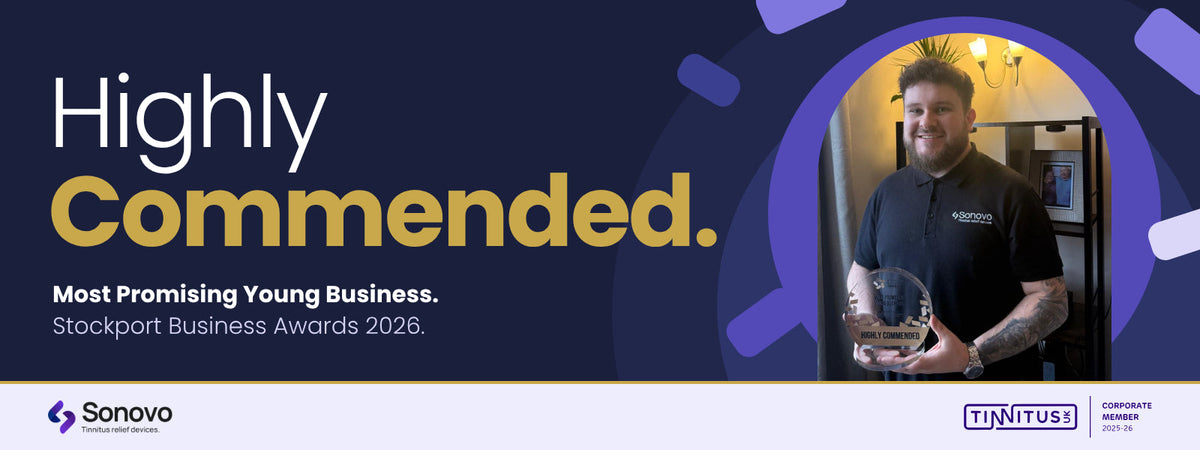
On Thursday 8 October I sat in a room at the Pyramid in Stockport, in a dinner jacket I don't often have a reason to wear, waiting to find out whether Sonovo had won Most Promising Young Business.
We didn't win on the night, and congratulations to everyone who did. It was a genuinely good evening, and being on that shortlist at all was more than I'd have imagined when I started.
Then, a little while later, the organisers got in touch. Sonovo had been awarded Highly Commended.
I grew up in Stockport, so being recognised here means a great deal. Thank you to the Stockport Business Awards team, and to CN Chartered Accountants, who founded and organise the awards, for a brilliant night and for the award itself.

What the award recognises is the year behind it, so here is what that year looked like.
It started because nothing helped.
I developed tinnitus in January 2021. I was 20, I'd had covid, and I'd been listening to music through earphones while I was ill. When I got better, the ringing stayed.
The days were manageable. The nights were not.
What I remember most isn't the sound. It's how little there was to read that was clear, honest and free of people selling cures. Four years later I started Sonovo to make the thing I'd been looking for.
What has happened since.
We became a Tinnitus UK Corporate Member, and we donate five per cent of every order to the charity. We're a King's Trust Supported Business, which came with an advisor who has been worth more than any amount of reading.
In April, Tinnitus UK shared my story, and the Mail on Sunday picked it up. An NHS audiology department asked to use one of our product images in their patient information. They approached us, and I don't think I've been prouder of an email.
The part that mattered most.
This autumn I started writing to tinnitus support groups around the country, not to sell them anything. I'd written a one-page, plain English guide to living with tinnitus: why it feels worse at night, what habituation means, and a few things that help.
Several groups now hand the guide to their members, and some asked me to come and talk. At one of those talks, someone asked why their tinnitus seems louder in the morning. Nobody had ever explained it to them, so they had assumed it was getting worse.
That's the part that stays with me, more than any award.
How to get involved.
If you run a tinnitus or hearing loss support group, we'd be glad to send you copies of the guide, free, for your members. We're also happy to come and talk, in person or online, and there is never a charge.
If you're an audiologist or run a hearing care practice, we'd welcome a conversation. We're not a hearing aid company. What we make sits alongside what you do, particularly at night when hearing aids come out.
If you work for a charity or organisation supporting people who live with tinnitus, please get in touch.
You can reach us at customercare@sonovo.co.uk.
If you're reading this at 2am.
You're not imagining it. At night the world around your tinnitus gets quieter, which is why it can seem louder. Many people find it gets easier to live with, slowly, and not in a straight line.
Talk to someone. Tinnitus UK's helpline is free on 0800 018 0527, Monday to Friday, 10am to 4pm, and there are support groups across the country who would be glad to see you. If your tinnitus is new or has changed, speak to your GP.
Five years on, I still have tinnitus every day. I also sleep. Both of those things are true, and for a long time I didn't believe the second one could be.
Jack Bridge is the founder of Sonovo. He grew up in Stockport and has had tinnitus since 2021.
This post shares personal experience. It is not a substitute for professional medical advice.




Share:
Why is tinnitus worse at night?